A Thucydidean approach
Strategic abstract
This essay answers the question: What prevents Greek–Israeli cooperation from maturing into a durable strategic alliance despite structural convergence in the Southeastern Mediterranean?
The prospects of strategic alignment between Greece and Israel can be examined through the Thucydidean triad of Interest, Fear, and Honour, operating within the shared geopolitical complex of the Southeastern Mediterranean. The convergence of interests and threat perceptions between the two states is real and structurally grounded. The limits of alignment emerge elsewhere. At the level of Interest, Greece and Israel function as subsystems within the same strategic environment. Energy security, maritime geography, and projects such as EastMed and IMEC anchor cooperation in long-term material calculations, while Cyprus operates as a geographic and strategic connector across maritime zones. Fear converges around Turkey as a destabilising, revisionist actor. Greece confronts direct military and political pressure, while Israel anticipates longer-term constraints linked to regional dominance, particularly in post-Assad Syria. The source of insecurity is shared, even if its immediacy differs. The principal divergence lies in Honour and its institutionalisation. Israel has embedded Honour within a security culture centred on strategic autonomy and credible deterrence. Greece has historically diluted Honour into procedural legitimacy through reliance on external guarantees, resulting in reactive rather than proactive deterrence. A Greek–Israeli strategic alignment is therefore plausible but incomplete. Its realisation depends less on external threats than on internal transformation—especially within Greece—concerning latent power, strategic culture, and the sustained credibility of deterrence.
Introduction
The prospects of strategic alignment between Greece and Israel can be coherently understood through the Thucydidean triad of Interest, Fear, and Honour, operating within the shared geopolitical complex of the Southeastern Mediterranean. The convergence of interests and threats is real; the divergence lies primarily in internal capacity, strategic culture, and doctrine.
Interest: Energy, Geography, and Structural Convergence
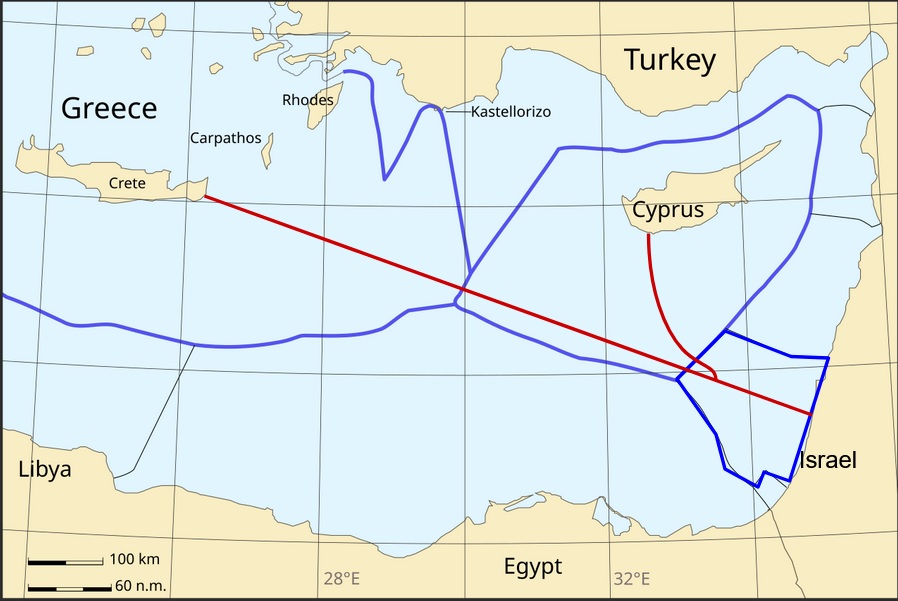
Greece and Israel are embedded within the same geopolitical complex of the Southeastern Mediterranean, with Cyprus functioning as a geographic and strategic connector through maritime zones and potential EEZ contiguity. The EastMed pipeline project, together with the IMEC mega-project, already demonstrates converging interests in the exploitation and protection of hydrocarbons — a strategic commodity of extremely low elasticity of demand and without immediately available substitutes. Energy security therefore constitutes a core national interest for both states, anchoring cooperation in material, long-term calculations rather than tactical convenience. At this level, Greece and Israel operate as subsystems within a shared strategic environment, rendering cooperation rational and structurally grounded.
Fear: Turkey as the Destabilising Variable
The dominant destabilising actor in this system is Turkey, driven by a revisionist strategy seeking absolute gains through disruption of the balance in the Southeastern Mediterranean. Greece experiences this threat directly through explicit military and political pressure. Israel encounters it more indirectly, particularly in relation to the control of post-Assad Syria, yet clearly perceives the emergence of a regionally dominant Turkey as a long-term strategic risk. Fear thus operates asymmetrically but convergently: Greece confronts immediate coercion; Israel anticipates future constraint. In Thucydidean terms, both states respond to the same source of systemic insecurity, even if the form and intensity differ.
Honour: Status, Sovereignty, and Deterrence Credibility
For Greece, Honour is closely tied to sovereignty, maritime rights, and resistance to imposed revision. For Israel, Honour manifests through strategic autonomy, regional credibility, and refusal to accept encirclement or subordination. In both cases, Honour constrains compromise and elevates the symbolic dimension of deterrence. Yet Honour also reveals asymmetry. Israel has embedded Honour within a security culture that accepts coercion and decisive action against adversaries as legitimate instruments. Greece, by contrast, has historically privileged external balancing and appeasement through participation in NATO and the European Union, diluting Honour into procedural legitimacy rather than credible deterrence.
Strategic Means: Where Alignment Becomes Conditional
While Interest and Fear converge, divergence emerges at the level of means. Israel has invested consistently in latent power — economic resilience, demographic prioritisation, and a security-oriented political culture — translating this into strong armed forces and a doctrine combining deterrence and coercion. Greece, relying heavily on EU membership and external guarantees grounded in international law, neglected latent power, weakening economic foundations, demographic vitality, and long-term military readiness. As a result, Israel approaches deterrence proactively, whereas Greece has managed deterrence failure reactively through escalation control and appeasement.
Prospects for Strategic Alignment
A strategic Greek–Israeli alignment is structurally plausible but not yet fully realised. Preconditions include: • prioritisation of a shared energy strategy linked to maritime zones, • strengthening of economic and latent power, particularly on the Greek side, • deeper diplomatic and military cooperation, including doctrinal exchange, • development of a joint deterrence framework extending from the Aegean to the Eastern Mediterranean, with recent acquisitions such as the Belharra frigates and Rafale fighters potentially consolidating deterrence in the Southeastern Mediterranean, • demonstrated political will to invoke and sustain deterrence.
Conclusion
In Thucydidean terms, Greece and Israel share Interest and Fear, but diverge in the institutionalisation and defence of Honour. This asymmetry currently prevents the relationship from maturing into a fully strategic alliance. The potential for convergence is real; its realisation depends less on external threats than on internal transformation—particularly within Greece—regarding latent power, strategic culture, and the credible use of force. Israel understands the limits of Greek commitment and calibrates its expectations accordingly, seeking no obligations beyond what Greece is demonstrably prepared to sustain.
See also: The Southern Rimland and the Logic of Strategic Depth